TRRAIN: automated document intelligence and verification across placement records
Every placement TRRAIN reports rests on supporting documents. EdZola built a verification engine that runs on Anthropic’s Claude: Claude vision reads each document as it’s submitted, the engine checks it against the programme record, and reviewers see exactly where to look. Built end to end with Claude Code.
At a glance
| Partner | TRRAIN (Trust for Retailers and Retail Associates of India) |
| Programme area | Livelihoods and placement |
| What we built | An automated document intelligence and verification engine, connected to LEAP, TRRAIN’s programme application |
| Runs on | Claude API (Anthropic): Claude Sonnet with Claude vision for field extraction, scanned and handwritten document reading, signature and employer evidence, watermark and workplace-photo review. Hosted on Zoho Catalyst, with results in Zoho Creator (LEAP). |
| Built with | Claude Code for design, build and testing. Claude for requirement analysis, test design and documentation. |
| Status | Live in production; used by TRRAIN’s team as part of everyday placement verification |
The challenge: every document checked by hand
TRRAIN works across retail and allied sectors to train young people and connect them to sustainable livelihoods. Placements are the outcome that matters most, so the evidence behind each one has to hold up for programme teams, leadership, funders, partners and auditors.
As placement volumes grew across the centre network, verifying that evidence stayed manual. Sound familiar?
- One document at a time. A staff member opened each supporting document and cross-checked the candidate, employer, role, pay and start date against what had been entered in LEAP. The same task, for every placement, in every batch, at every centre.
- Reading came before checking. Documents arrived as scans, phone photos and Word files, some handwritten or poorly lit. Simply reading them was a job in itself.
- Slips and real problems looked the same. A typing error and a substituted document produced the same confusion on a manual read. Only the reviewer’s attention told them apart.
- No memory across reviews. A reference number reused on two candidates’ documents, or the same template resubmitted under a new name, went unnoticed unless one person happened to remember it.
The solution: an engine that reads first
EdZola built the verification engine as a serverless service on Zoho Catalyst and wired it into LEAP. Verification happens on submission, either for records a reviewer selects or in a scheduled overnight run, instead of waiting in a separate review queue.
Where the result shows up
Reviewers see each placement’s status, score, risk result and a short anomaly summary in LEAP, with the full report one click away. A newer document becomes the current result while earlier results stay on record as history.
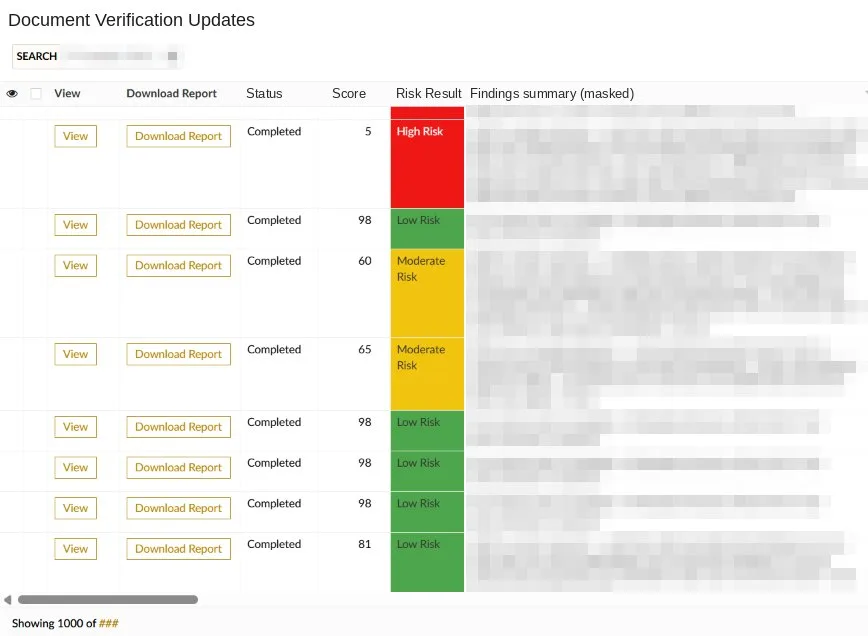
What reviewers see in LEAP: status, score and risk result for every placement, with the full report one click away. Findings and identifying details are masked.
How Claude runs this system
In production, on the Claude API
- Claude Sonnet for field extraction. Claude is the primary extraction engine: candidate, employer, role, pay, joining date, signatory, reference ID and multi-candidate rows.
- Claude vision for documents. Scanned, photographed and handwritten documents are read through Claude's document vision, so a scan is checked just as fully as a typed file.
- Claude vision for evidence review. Signature evidence, employer identity, watermark observation and workplace-photo review, with an optional second independent Claude review and a deeper forensic mode on Claude Opus.
- Every Claude call tracked. Each call is logged in the Catalyst Data Store, with usage and cost summaries available through the service.
In delivery
- Claude Code to design, build and test the Catalyst services, the scoring rules, the LEAP integration and the PDF report generator.
- Claude for requirement analysis, test-case design and the technical and user documentation handed over to TRRAIN.
Claude reads; a transparent rule engine scores. Every deduction and cap is written down, so TRRAIN can see exactly why a document scored the way it did.
Results: verification TRRAIN can stand behind
The engine has been live for the last few months and has verified more than 3,200 placement documents. TRRAIN’s team now:
- Starts from a scored result, not a blank document. Every submission arrives already read, compared and scored.
- Spends human review time where it matters. The team focuses its attention on documents flagged as Moderate or High Risk.
- Separates slips from real problems. Field-level comparisons show whether a mismatch is a typing error or something that needs follow-up.
- Catches reuse across the programme. Repeated references, recycled templates and duplicate files surface automatically, wherever they were first submitted.
- Has an audit trail for every placement. Each report records the evidence and reasoning behind the result, ready for funders and auditors.
What other teams can learn
Put the AI inside the workflow people already use. The Claude-powered verification engine does one focused job and returns its answer to LEAP, where TRRAIN’s team already follows each placement.
Let the model read and let the rules decide. Claude handles the messy part, understanding documents that arrive in every format. Scoring stays rule-based and explainable, so the team trusts the result and can question it.
Give the system a memory. Most problems only show up when today’s submission is compared with everything that came before.