Frappe and ERPNext for Nonprofits: Grant Budgets, FCRA and Donations Tested (2026)
Most nonprofit finance software is sold on fundraising. The harder problem, for most finance teams we work with, is control: making sure grant money is spent only on what the grant allows, foreign money stays in FCRA accounts, and nobody approves their own purchase. Sound familiar?
Frappe (ERPNext with Frappe HR) is an open-source ERP with no per-user licence. We wanted to know how it holds up for an Indian nonprofit, so we set up the same demo organisation we used for our Zoho Books and Zoho ERP guides on a live Frappe Cloud site and ran 44 scenarios through it.
The short answer: Frappe is strong on the money-control side of grant management, and weak on the fundraising side out of the box. 34 of the 44 scenarios (77%) worked natively or with configuration.
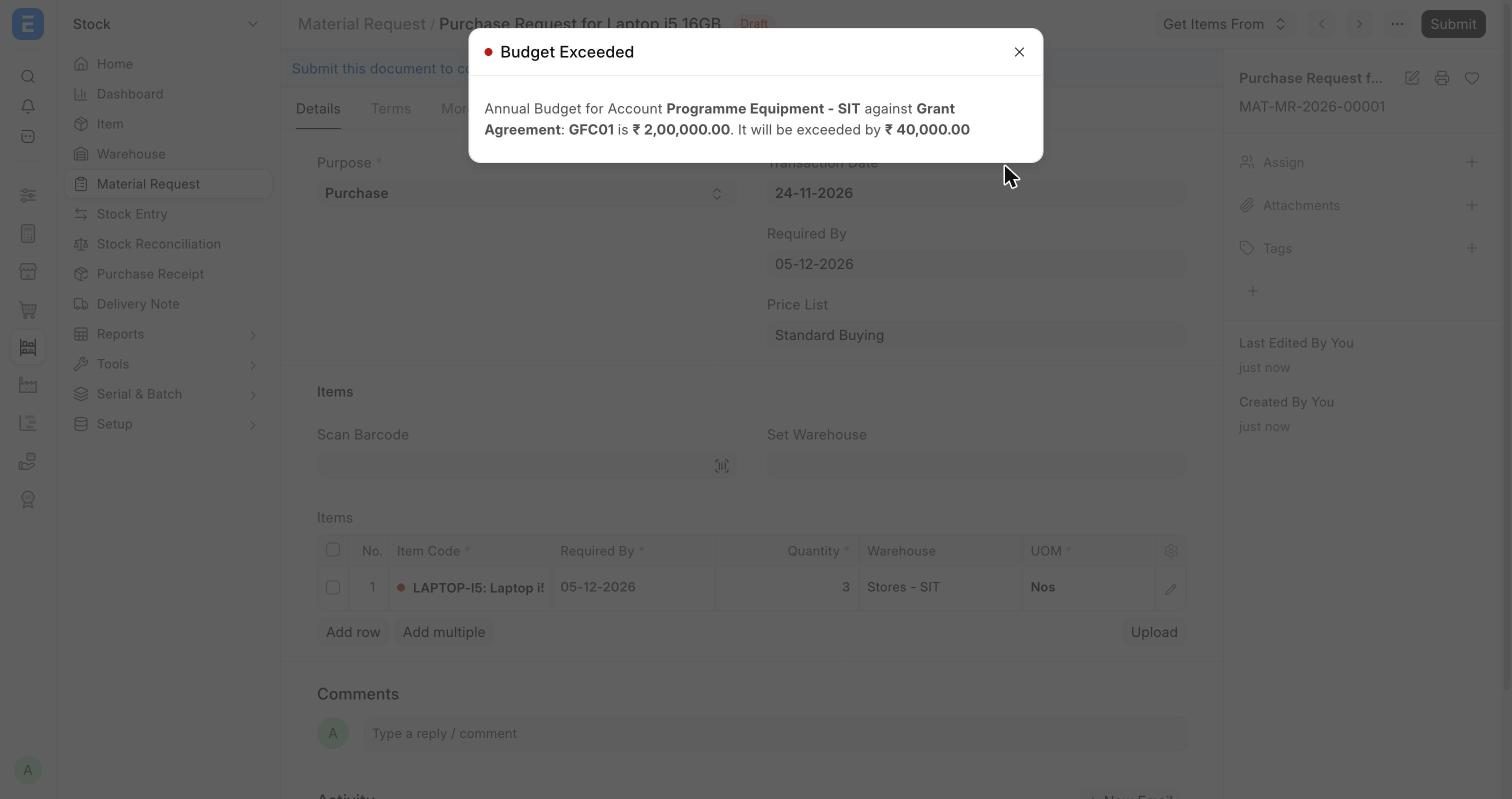 A purchase request stopped on submit: the grant, the budget head and the overrun are named. Every name and number in this guide is made up.
In this guide
- How we tested
- Grants as an accounting dimension
- Grant budgets that stop spending
- FCRA separation
- Procurement and approvals
- Payroll, expense claims and travel
- Donations, 80G and Form 113
- Reporting and audit
- Where Frappe falls short
- Frappe or Zoho ERP?
- FAQs
How we tested
Our demo nonprofit, Sitara Foundation, has about 200 staff, two programmes in Tamil Nadu and Karnataka, two foreign grants, one ₹1.6 crore CSR grant and individual donors. We ran it on Frappe Cloud (Mumbai region) with ERPNext 16, Frappe HR, India Compliance, India Payroll and the Frappe Non Profit app, using made-up names, PANs and amounts.
Each scenario was rated Native, Configurable (no code), Custom build (code) or Gap. A working nonprofit site, apps installed and set up, took about an hour.
Grants as an accounting dimension
In Frappe the grant becomes a tag on every ledger line. We created a Grant Agreement record and turned it into an accounting dimension, alongside geography and department, with no code. From then on every purchase request, order, bill, payment, expense claim and journal carried a grant on each line.
Everything else in this guide sits on that one decision. Getting it right took us a few attempts: naming, which accounts make the grant mandatory and how multi-grant bills behave all matter.
Grant budgets that stop spending
This is where Frappe is strongest. A budget per grant and expense head stops a request at the moment it’s raised, and open requests count as committed money.
- A purchase request over budget (Native). A request for three laptops on a foreign grant’s ₹2 lakh equipment line was refused on submit: it would overspend by ₹40,000.
- Commitments (Native). We cut it to two laptops and submitted. A second request for one more was refused by ₹20,000, because the first open request already counted. Cancelling the first released the money.
- Expense claims (Native). A ₹15,000 travel claim against a ₹10,000 travel line was refused the same way.
- Budget against actuals (Configurable). The standard variance report has no committed column, so we built a commitments report in the browser in about an hour.
On Zoho, the same budget block needed our hardest custom build.
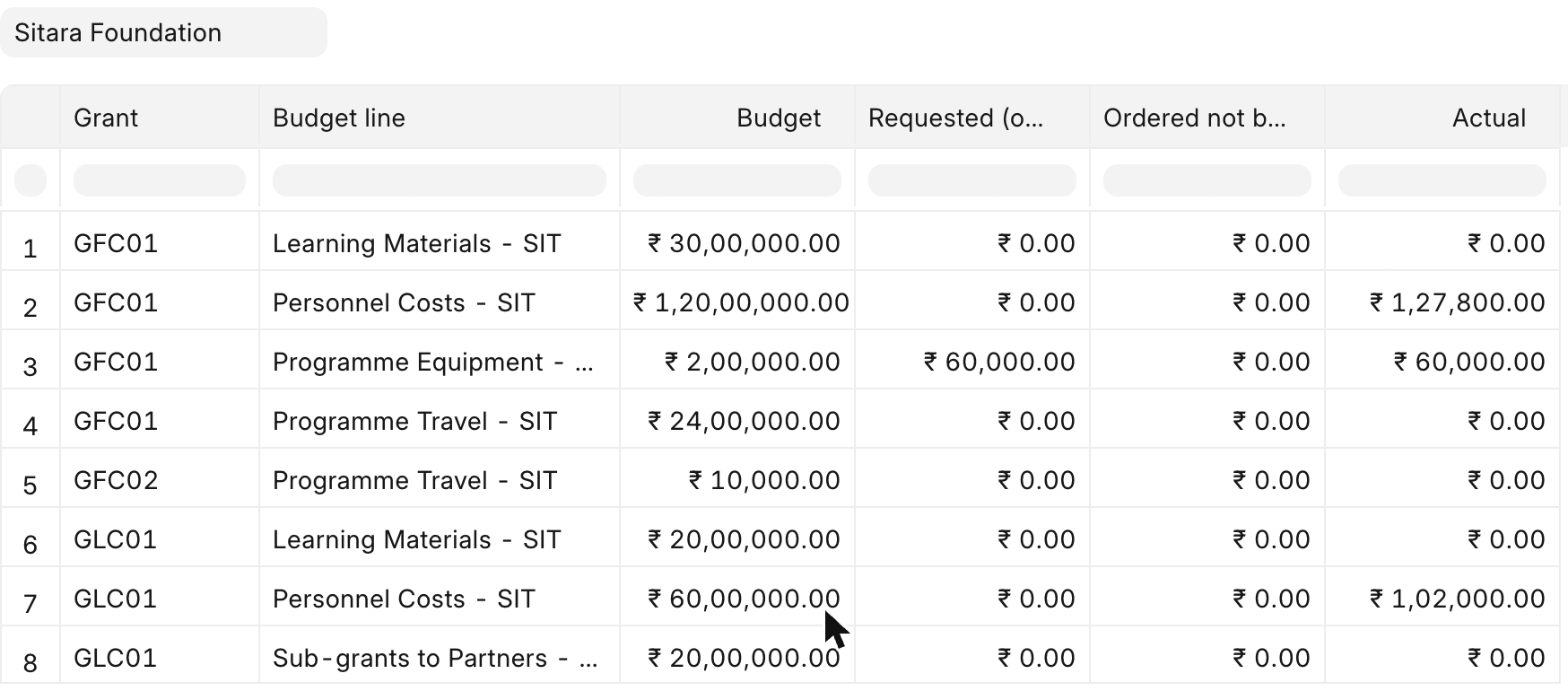 Money requested on a grant shows as committed before any bill arrives.
FCRA separation
Frappe can keep foreign and local money apart with no code. A dimension filter restricts which grants a bank account accepts, so an FCRA account can only ever carry FCRA grants.
- Foreign receipts (Native). A dollar tranche landed in the FCRA receipt account and ERPNext booked the exchange gain itself.
- Transfers out (Native). Moving money from the FCRA utilisation account to the local account was refused, whichever way we tagged it.
- Payments (Native). Paying a foreign grant’s bill from the local account was refused. Paying it from the FCRA utilisation account worked.
What the filter doesn’t do: watch the 20% cap on administrative expenses from foreign money, or produce FC-4 figures. Those need a report or code.
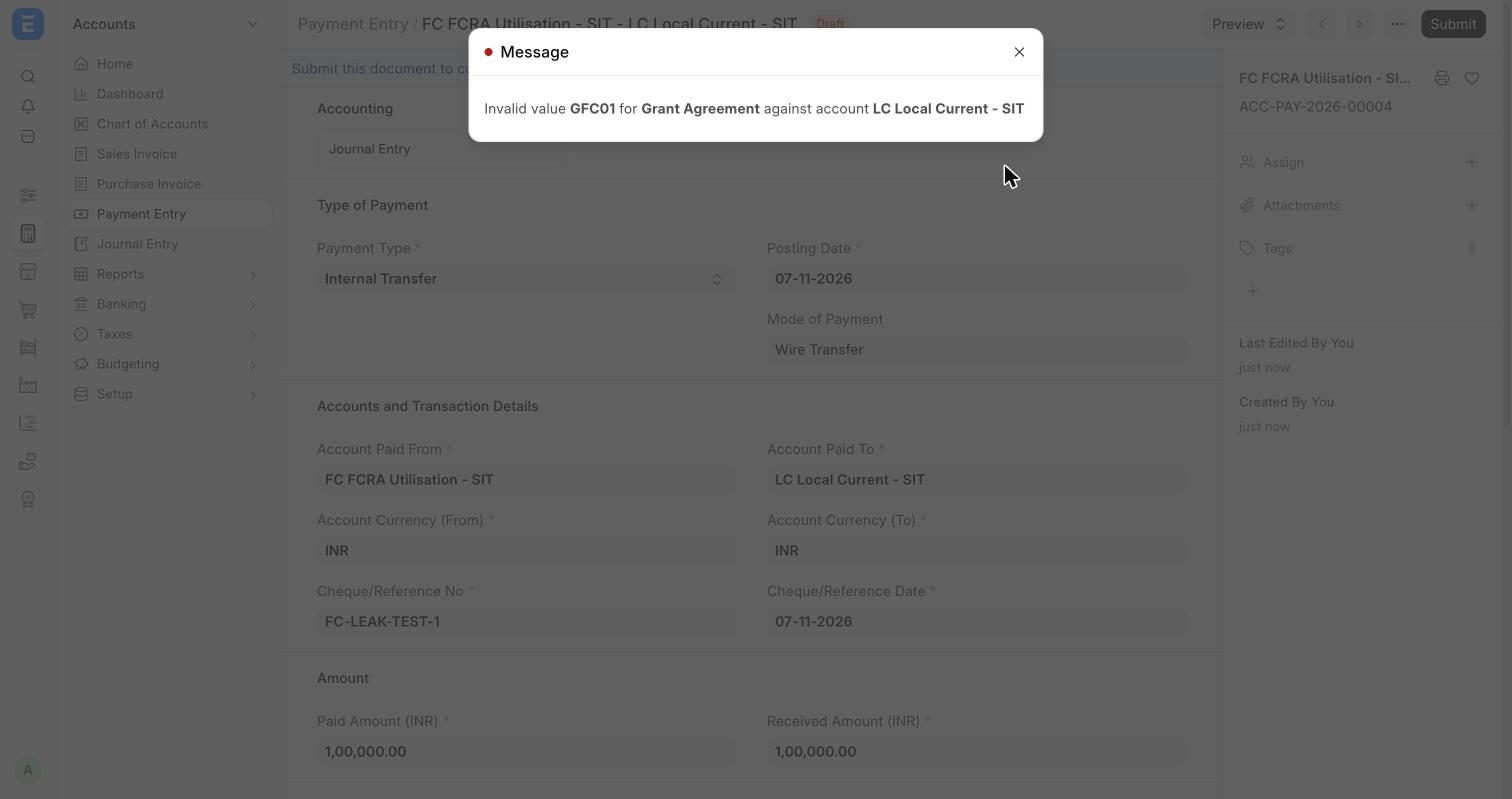 Moving FCRA money to the local account is refused, with no code.
Procurement and approvals
The request, order, receipt and bill chain is standard ERPNext, and it’s stricter than Zoho.
- Approval by amount (Configurable). A ₹1.5 lakh request for learning kits went to finance for a second approval, and the form locked while it waited.
- Price match (Native). A bill at ₹65,000 against an order and receipt at ₹60,000 was refused, not just flagged.
- One bill, three grants (Native). A staffing agency bill split across three grants worked out GST and TDS itself, and the ledger kept the grant, programme and geography on every line.
- Maker-checker (Configurable, with care). An administrator could approve their own request at the first step. Test approvals with real users before go-live.
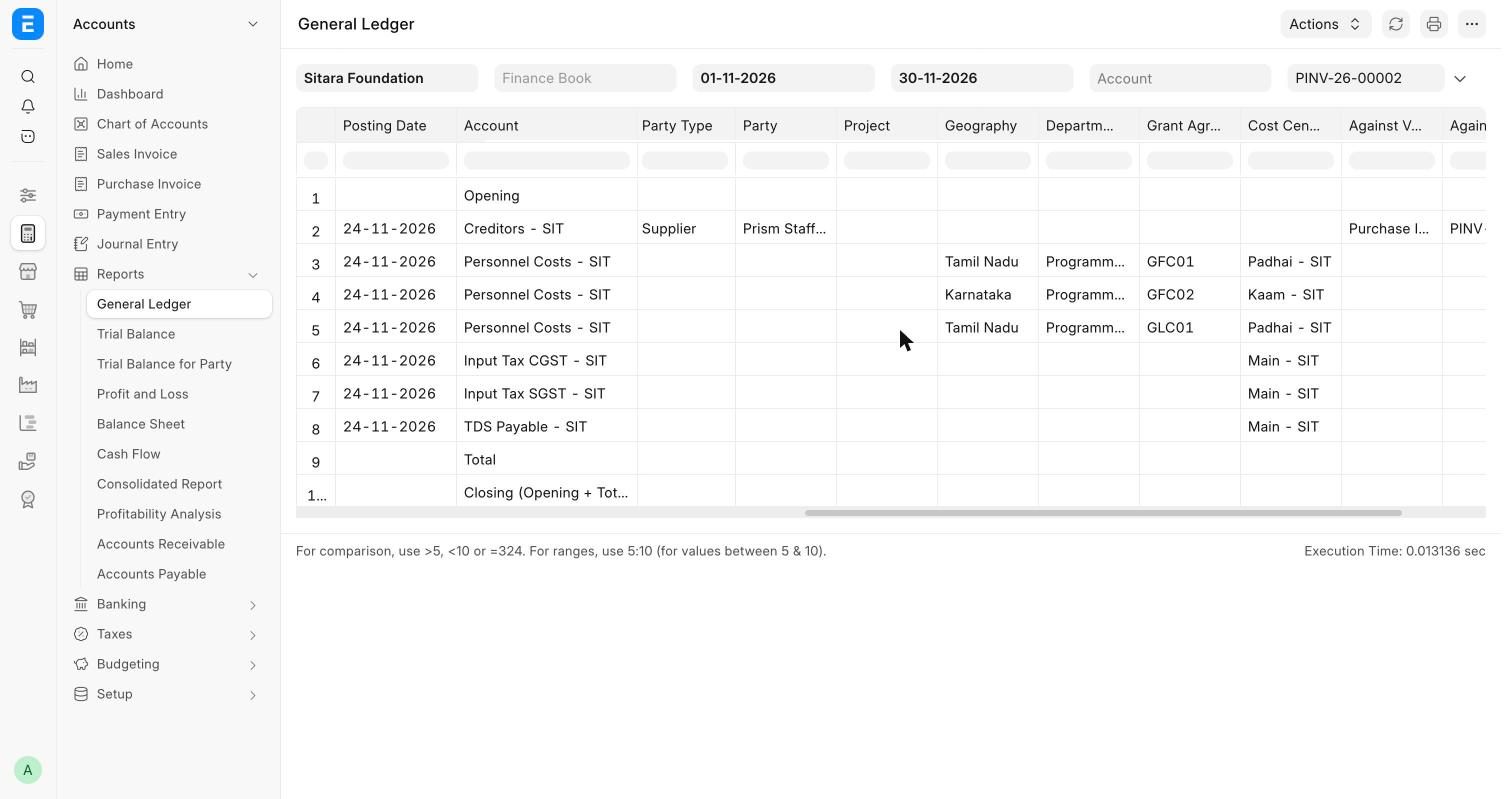 One bill, three grants. Each ledger line keeps its grant, geography and programme.
Payroll, expense claims and travel
- Payroll by programme (Configurable). Payroll ran and split salaries across programmes by each person’s percentage.
- Payroll by grant (Gap). A payroll run takes one grant for everyone. Charging salaries to three grants took a separate journal.
- Expense claims (Native). Claims respect grant budgets.
- Travel policy (Gap). There’s no per diem, mileage rate, city tier limit or claims-per-quarter rule in Frappe HR.
- Volunteers (Gap). An expense claim needs an employee, so volunteers are paid as suppliers.
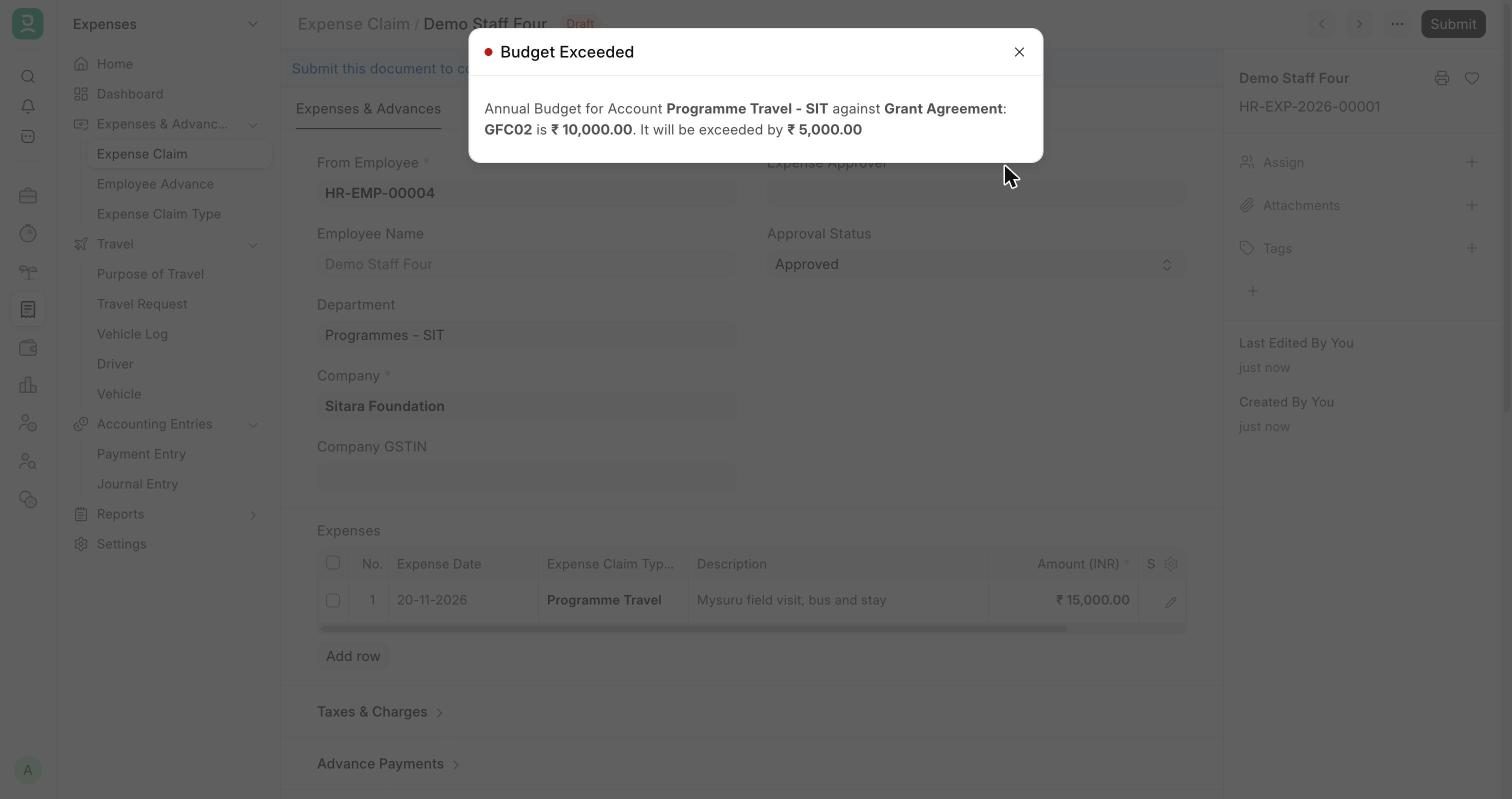 The grant budget check runs on expense claims too.
Donations, 80G and Form 113
This is Frappe’s weakest area for an Indian nonprofit. The Non Profit app records a donation, but posts nothing to the accounts.
- Donations in the books (Gap). The donation form has no fund, currency, cost centre or grant, and submitting it created no ledger entry. We posted a journal by hand.
- 80G checks (Gap). An 80G certificate was issued for a ₹5,000 cash donation, which the law doesn’t allow above ₹2,000, and the default print showed a total of ₹0.00.
- A no-code fix (Configurable). A workflow rule then stopped cash gifts above ₹2,000 from being marked 80G.
- Form 113 (formerly 10BD) (Gap). There’s no export. It needs a report.
- Duplicate donors (Gap). A second donor with the same PAN was accepted.
Zoho ERP handles all of this out of the box.
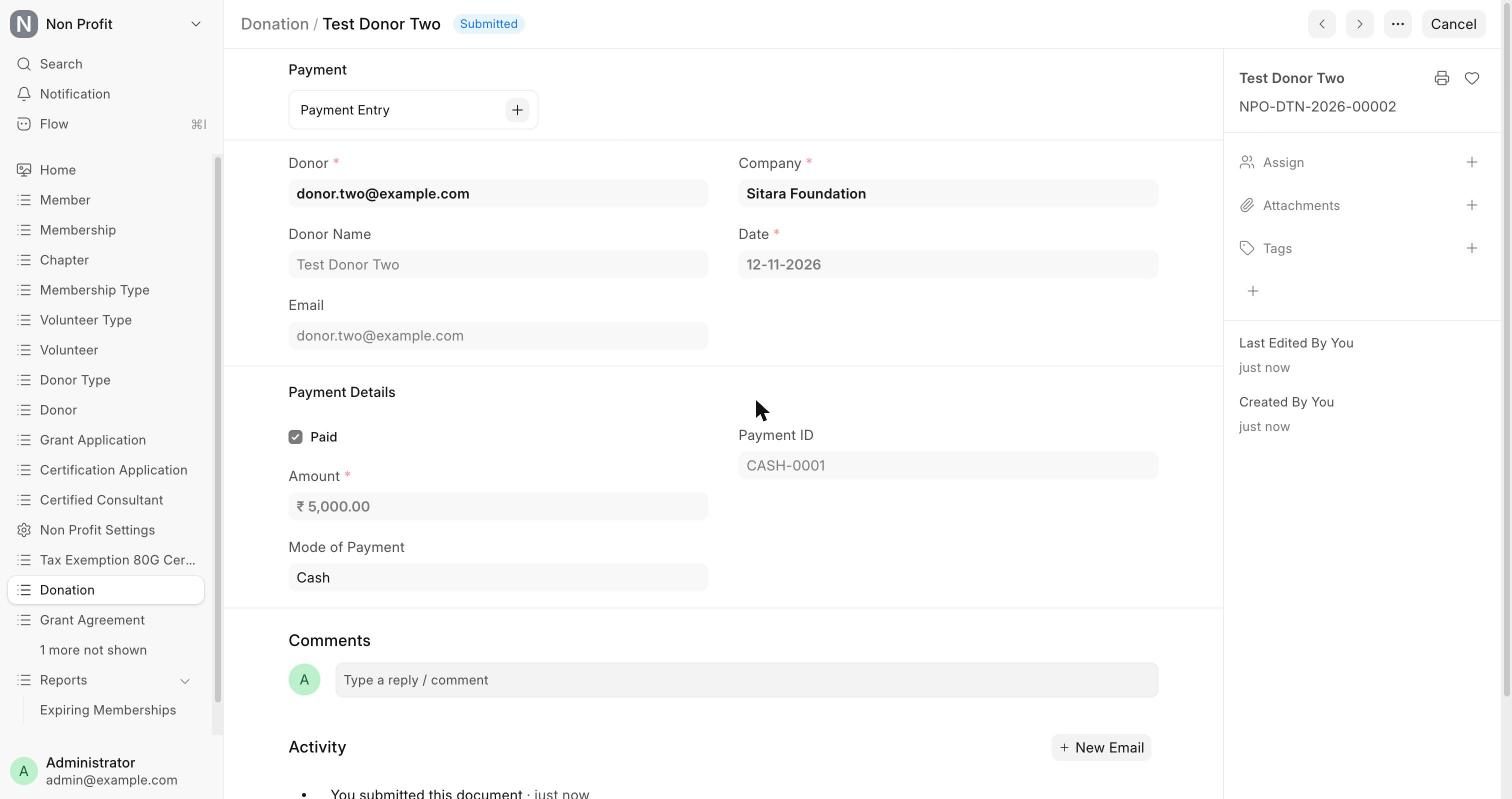 The standard donation form. Nothing on it says which fund the money belongs to.
Reporting and audit
The reports an auditor asks for are native, and every one can be filtered by grant: General Ledger, Trial Balance, Profit and Loss and Budget Variance. Closed accounting periods refuse back-dated entries. Submitted documents are locked, and changes go through cancel and amend with the history kept. There’s a REST API on every record and the option to self-host.
What’s missing is the grant officer’s view: the money position of each grant (received, spent, committed, spendable), donor statements, utilisation certificates and a calendar of donor reports. These can be built, but none come ready-made.
Where Frappe falls short
We logged 18 limitations. The ones that matter for grant and fund management:
| Area | Limitation | Workaround |
|---|---|---|
| Donations | Donations post nothing to the accounts | Custom fields and a journal per donation, or a custom app |
| 80G and Form 113 | Any donation gets a certificate; no Form 113 | A workflow rule, a print format and a report |
| Hosting | The shared Frappe Cloud plan can’t run custom server code | A private bench, or self-hosting |
| Payroll | One grant per payroll run | A reclass journal from an allocation table |
| Travel | No expense policy, per diem or mileage rules | Custom fields and validation |
| Approvals | Workflow conditions can’t total a request’s lines | Put amount limits on the purchase order |
| Data quality | Duplicate donor PAN and supplier GSTIN accepted | A unique field or a server check |
| Non Profit app | Version 0.0.1 when we tested | Treat it as a starter kit |
Almost all of Frappe’s nonprofit fit comes from core ERPNext, not from the Non Profit app.
Because Frappe is open source, these gaps don’t have to wait for the vendor. A small Frappe app can hook into ERPNext’s own documents. We wrote one to test the idea, and it closed eight of these limitations, from donation posting and 80G rules to payroll grant splits and a travel policy. The catch is hosting: custom apps need a private bench (from ₹2,050 a month when we tested) or a self-hosted server, not the ₹820 shared plan.
Frappe or Zoho ERP?
On the 34 scenarios we ran on both, Frappe did better on 10, worse on 5 and the same on 19. The two are strong in opposite places.
| Frappe (ERPNext) | Zoho ERP | |
|---|---|---|
| Grant budget stops a request | Native | Custom build |
| Commitments reserve budget | Native | Custom build |
| FCRA account separation | Native | Custom build |
| Donations, 80G, Form 113 | Custom build | Native |
| Travel policy, per diem, mileage | Custom build | Native |
| Payroll split across grants | Journal | Journal |
| Users | No per-user licence | Per-user licence |
| Hosting | Frappe Cloud or self-host | Hosted by Zoho |
Choose Frappe when the pain is controlling grant money: budgets per grant, FCRA separation, procurement approvals and audit. It costs less, puts no limit on users, and the gaps can be closed in code, ideally with a developer on hand. Choose Zoho ERP when the pain is fundraising and donor receipting, and the team wants nothing to host.
The full side-by-side, with Zoho Books, is in our comparison of Zoho Books, Zoho ERP and Frappe for nonprofits.
Need grant controls on top?
Frappe’s ledger is strong, but the grant officer’s side (money position per grant, donor statements, utilisation certificates, a reporting calendar) still has to be built. We’re building that as FundZola for Frappe, an open-source app on the same model as FundZola for Zoho. It’s in progress. Compare the setups to see what’s available today.
FAQs
Is Frappe or ERPNext good for nonprofits?
For controlling grant money, yes. Budgets per grant that stop overspending, FCRA account separation and procurement approvals all work without code. For fundraising it’s weak out of the box: donations don’t post to the accounts and there’s no 80G check or Form 113 report.
Does Frappe have a nonprofit app?
Yes, Frappe Non Profit adds donors, donations and memberships. It’s early (version 0.0.1 when we tested), and most of Frappe’s nonprofit fit comes from core ERPNext features: accounting dimensions, budgets, filters and workflows.
How much does Frappe cost for a nonprofit?
There’s no per-user licence. Frappe Cloud’s shared plan cost Rs 820 a month when we tested, but it can’t install custom apps. A private bench started at Rs 2,050 a month, or you can self-host. Budget for setup and a developer on hand.
Tested by EdZola on Frappe Cloud in November 2026 with ERPNext 16, using a made-up organisation. Every name, PAN and amount is invented. Frappe and its apps change often; check current behaviour and pricing before relying on any finding.